DeedCheck Local · Cook County 101
Whose name is on your deed right now? Here is how to find out.
The county has a public answer. Most Cook County homeowners have never actually looked.
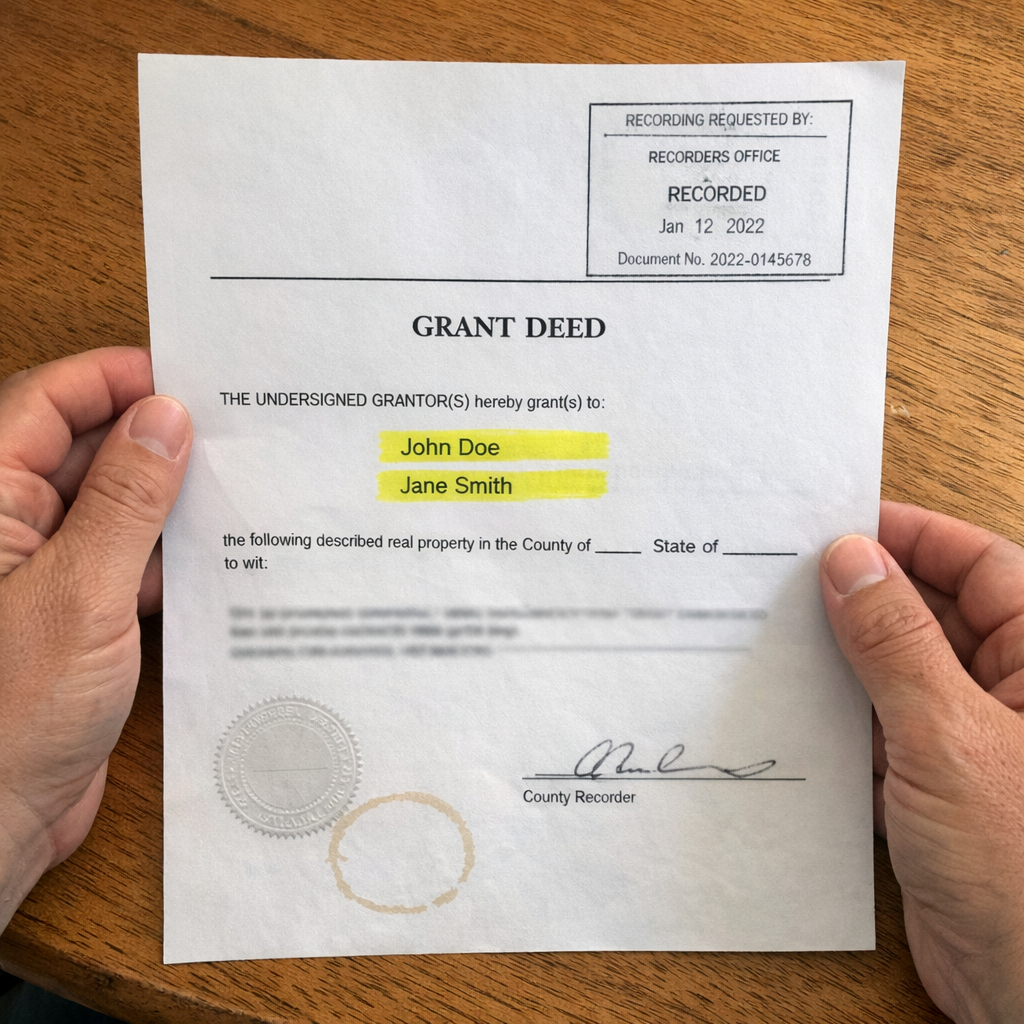
Illustrative example. The names shown on the document are fictitious.
Here is a simple question that trips up almost everyone who owns a home: whose name is on your deed today? Not the day you closed. Today. Most people answer with the name they remember signing. But a deed is a living record. It can be re-recorded, corrected, added to, or in rare cases changed by someone who should not have touched it. The name you remember and the name on file are not always the same thing, and the only way to know is to read the current record.
The good news is that this is public information. In Cook County, the names on your latest recorded deed are not a secret you have to pry loose. They are sitting in the recorder’s index, waiting for someone to look. The strange part is how rarely anyone does.
What a recorded deed actually shows.
A deed names who transferred the property (the grantor) and who received it (the grantee). It carries a document or recording number, a recording date, and a deed type, such as a warranty deed or a quitclaim deed. When you pull the record, those indexed names should match the names on the first page of the deed itself. On a recent test parcel, they did, and the mortgage recorded the same day lined up too. That match is what you are checking for.
The gap between what you signed and what is recorded.
Closings are a blur of paper. Something can be re-recorded to fix a typo. A name can be added or removed in an estate or a refinance. Each of those is usually routine. But each one also changes the record, and if you have not looked since closing, you are working from a memory that may be years out of date. Pulling the current deed replaces the memory with the actual document.
Why the assessor page and the deed can disagree.
This one surprises people. The assessor’s site and the recorder’s deed are two different systems that update on two different schedules. It is normal for a taxpayer name on the assessor page to lag behind, or read differently from, the grantee names on the latest recorded deed. A mismatch is not automatically alarming. It usually just means you are looking at two sources that have not caught up to each other. Knowing which source answers which question is half the skill.
How to read your own deed, free.
You can do a basic version of this yourself in a few minutes:
- Get your PIN. It is on your tax bill, or look it up by address on the Cook County Assessor site.
- Search the recorder index by PIN. Open the most recent deed listed.
- Match the names and the deed type. Confirm the indexed grantee names match the first page, and note whether it is a warranty or quitclaim deed.
- Record the dates. Note the recording date, the date you checked, and how current the index is.
If the record is clean and easy to read, you are finished, and it cost nothing. The free self-check guide below gives you the exact links.
When you want a person to read it for you.
Not every record is tidy. Trusts, condos, multiple PINs on one address, name variations, and recent filings can all make the index hard to interpret. A DeedCheck Local report is a person pulling your record and handing you one plain, dated document: the names on the latest deed we could verify, the deed type, the recording date, and how current the index was on the day we checked. If a result is inconclusive, we say so rather than turning a gap into reassurance. One payment, $14.95, no subscription.
Your Cook County deed check
A human reads your record and sends one dated report. Free self-check guide included.
Not title insurance or legal advice. The free Cook County public lookup is always available on its own.
Why people are checking now
Coverage of property-record fraud has pushed more homeowners to read their own records. Local reporting described a Burbank case in which a property was allegedly sold using a forged deed. A separate federal case in St. Louis documented guilty pleas tied to at least 14 properties. An Arizona landowner told a TV station he learned of a sale only when a closing letter arrived.
Sources: Riverside-Brookfield Landmark (Burbank); U.S. Department of Justice (St. Louis); KOLD News (Arizona). Examples from public reporting, not a measure of how common this is.
The 30-second version
- The name on your deed today may not be the name you remember signing.
- A deed shows the grantee names, the deed type, the recording number, and the date.
- The assessor page and the recorder deed can disagree, and that is often normal.
- Check it free in four steps, or get a dated, human-reviewed report for $14.95.
Questions people ask
Can I not just look this up for free?
Yes, and we show you how on this page. You are paying for a person to pull and read your record and hand you one plain, dated document, which helps when the index is confusing or you would rather not do it yourself.
What does the report actually tell me?
The names on the latest deed we could verify, the deed type, the recording date, and how current the index was on the day we checked. It is dated public-record evidence, not title insurance and not legal advice.
The assessor site shows a different name than I expected. Is that bad?
Not necessarily. The assessor and recorder systems update separately, so a lag or a difference is common. The report focuses on the recorded deed and tells you what the record shows.
How current is it?
County recording and indexing run on a lag. Every report shows the date checked and how current the index was, so you know what it covers. A recent check cannot rule out a filing that has not been indexed yet, and we say so.
Is there a subscription?
No. One $14.95 report, no recurring charge.